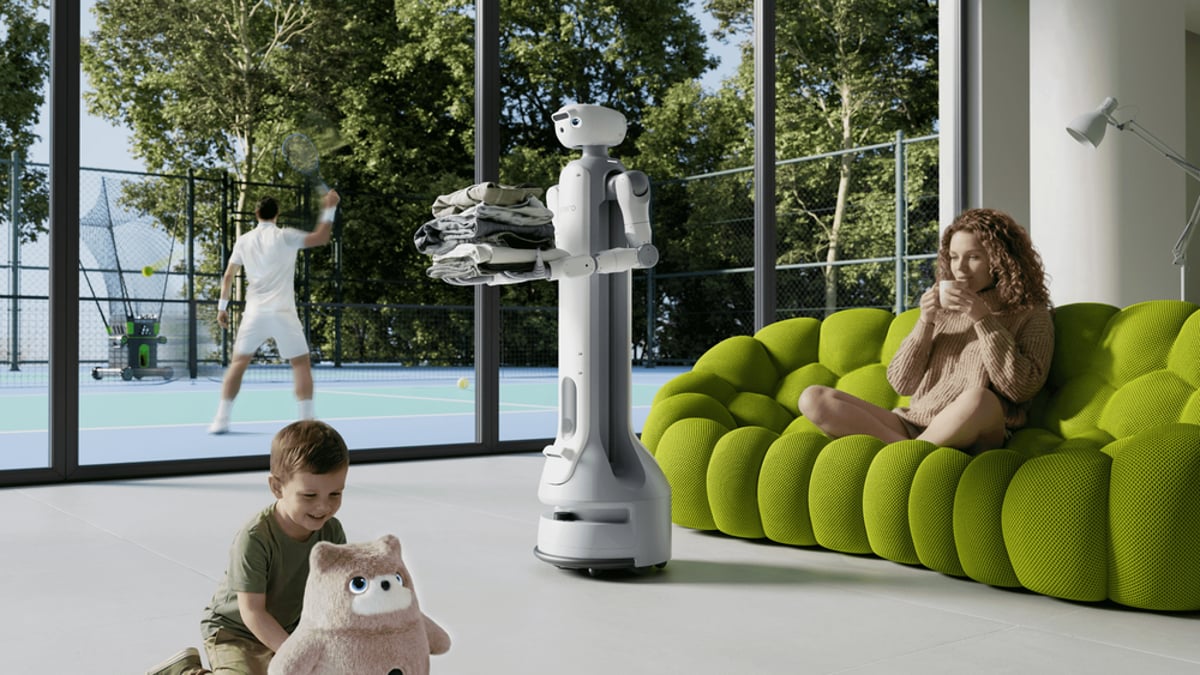
SwitchBot just threw down the gauntlet in the household robotics race. The smart home company is unveiling the Onero H1 at CES 2026, calling it 'the most accessible AI household robot' that can handle everyday chores from laundry folding to window washing. With articulated arms, on-device AI, and a wheelbase that lets it navigate around your home, it's the company's most ambitious move yet into the generalist robot space.
SwitchBot is making its boldest move yet into the household robotics arena. The company unveiled the Onero H1 at CES 2026, positioning it as the next frontier in home automation after years of focusing on specialized devices. Videos shared ahead of the announcement show the wheeled humanoid completing a surprisingly impressive range of household tasks, from filling coffee machines and making breakfast to washing windows, loading washing machines, and folding clothes with articulated precision.
What makes the Onero different from other humanoid robots making the rounds at tech conferences is SwitchBot's design philosophy. Rather than chasing the legs-and-torso form factor favored by Boston Dynamics and others, the company went with a pragmatic approach: articulated arms and hands mounted on a wheeled cylindrical base. It's not trying to walk up your stairs or navigate uneven terrain. Instead, it's built to handle the smooth, flat surfaces most of us actually live with while maintaining the dexterity needed for delicate tasks.
The robot packs some serious hardware under that cylindrical shell. SwitchBot equipped the Onero with 22 degrees of freedom across its articulated joints, which gives it impressive range of motion compared to simpler robotic arms. For context, Boston Dynamics' humanoid Atlas achieves 29 DoF in its upper body alone, so the Onero sits in that ballpark of precision. The perception system relies on multiple cameras embedded throughout the robot's head, arms, hands, and midsection, feeding real-time visual data to power its movements.
Here's where things get technically interesting. The Onero runs an on-device OmniSense vision-language-action model that processes visual information, depth data, and tactile feedback to understand what it's looking at and how to interact with it. That's not just pattern matching against pre-programmed tasks. The VLA model enables the robot to learn and adapt across different household scenarios, recognizing object shapes, positions, and interaction states on the fly. It's the same kind of multimodal intelligence that's been powering recent breakthroughs in AI, but compressed down and optimized to run locally on the robot without constantly phoning home to cloud servers.
Of course, there's a massive gap between what demo videos show and what actually happens when a robot encounters your cluttered, real-world home. Anyone who's been paying attention to household robotics over the past year knows the drill. We see impressive footage of robots folding towels with precision, then reality delivers something far messier. Jennifer Pattison Tuohy from The Verge noted this skepticism directly: "Video demos are very different from the real thing," and she's planning hands-on testing at the show floor this week.
The Onero launch reveals something bigger about how the home automation industry is evolving. SwitchBot is essentially asking a fundamental question: should households invest in specialized single-purpose robots (like the robot vacuum that just does vacuuming) or generalist systems that adapt to multiple tasks? That tension plays out differently depending on your living situation. Many household chores remain genuinely difficult to automate without substantially redesigning your home. Staircases kill wheeled robots. Delicate items confuse rigid grippers. Unexpected obstacles stall pre-programmed routines.
The smart middle ground SwitchBot seems to be pursuing is an embodied smart home orchestrator. Rather than the robot doing everything itself, it coordinates with SwitchBot's existing ecosystem of task-specific devices like robot vacuums, air purifiers, and humidifiers. That's the same strategy Samsung adopted with its Ballie and LG with its AI agent. It's a more realistic path to making humanoid robots actually useful in average homes than trying to build a one-size-fits-all machine.
On the availability front, SwitchBot says the Onero H1 and its separate robotic arms component, the A1, will soon be available for preorder through the company's website. But here's the catch: no pricing announced yet. That's a crucial detail hanging over the entire product. Is this going to be a $50,000 automation system? $100,000? A more mass-market $10,000 to $20,000? The price point determines whether this is an exotic luxury item for early adopters or actually "accessible" as SwitchBot claims.
The Onero H1 represents where consumer robotics is heading in 2026: practical, incremental progress rather than sci-fi breakthroughs. SwitchBot's bet on a generalist platform that orchestrates your smart home ecosystem feels more grounded than some of the bipedal humanoid promises floating around, but it still faces the brutal reality that real homes are messier and more unpredictable than demo stages. The real test comes when Onero H1 units hit actual homes, grapple with unforeseen obstacles, and try to handle tasks they weren't specifically programmed for. Price will make or break whether this becomes a meaningful category or stays a niche luxury item for tech enthusiasts.