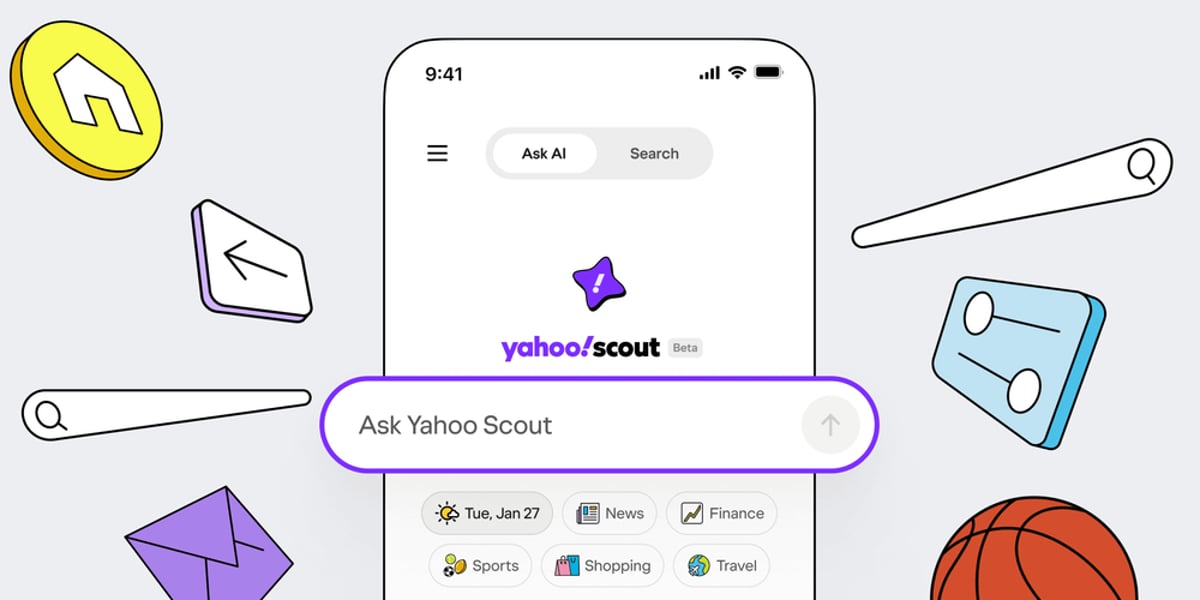
Yahoo just launched Scout, an AI-powered answer engine that's taking a different approach to the search wars. Unlike ChatGPT or Perplexity, which bury source links, Scout puts them front and center - displaying up to nine clickable links per query. Built on Anthropic's Claude model and integrated across Yahoo's search properties, Scout represents the company's bet that the future of AI search looks a lot like its past as 'Jerry's guide to the world wide web.'
Yahoo is making its big AI play, and it looks nothing like what Google or OpenAI are building. The company just launched Scout, an AI-powered answer engine that's betting the future of search isn't about hiding the web - it's about highlighting it.
Scout went live today as a tab in Yahoo's main search engine (still the third-largest in the US, CEO Jim Lanzone keeps reminding people), a standalone web app at scout.yahoo.com, and the centerpiece of Yahoo's revamped mobile search app. Ask it a question and you get something familiar if you've used Perplexity or Google's AI Mode - a conversational answer with context. But here's where it diverges: Scout loads each response with prominent blue hyperlinks, typically nine per page, plus a master list of all sources.
"It's moved from 'how do I find things on the internet' to weeding through clickbait and now AI slop," Eric Feng, who runs Yahoo's research group and led the Scout project, told The Verge. The pitch is simple: use AI to cut through the noise, but don't pretend the web doesn't exist.
Under the hood, Scout runs on Anthropic's Claude model, paired with what Feng calls "Yahoo content, Yahoo data, Yahoo personality." That's where Yahoo's quirky advantage kicks in. The company operates massive content verticals - Yahoo Sports, Yahoo Finance, a substantial newsroom, plus partnerships with publishers across the web. It's essentially a content machine with decades of reference material to feed an LLM. Web search data flows from Yahoo's longstanding partnership with Microsoft and Bing.
"We're the only ones who can take our user data, our usage data, our content, our relationships and information, and combine that with everything we know about search into an AI answer engine," Lanzone said. Google would dispute that claim - it has similar advantages plus vastly more users. But Yahoo has one critical edge: no massive search-ads empire to protect.
That's the strategic opening. Google needs to slow-walk AI Mode's takeover of traditional search because it risks cannibalizing billions in ad revenue. Yahoo faces no such constraint. Lanzone says Scout won't immediately replace Yahoo Search, but made it clear that's the trajectory. "Free search is extremely important," he noted, though Yahoo isn't ruling out a paid tier down the line.
The business model is already in place. Scout launches with affiliate links for shopping queries and an ad unit at the bottom of search results - the same monetization playbook every AI search product is converging on. Yahoo's existing ad infrastructure means it can scale this faster than venture-backed competitors still figuring out unit economics.
What Yahoo isn't doing: building its own foundation model. "Doing that is very expensive," Lanzone said bluntly. "We think we can best serve our users not so much with the model, but with the grounding data and the personalization data that we can add on top of other people's models." It's a pragmatic call that keeps Yahoo focused on its actual differentiator - content relationships and web curation.
In early testing, Scout's web-first approach shows up immediately. A query about winter storms returned a one-paragraph summary with three inline links, followed by sections on local conditions, forecast details, and a "Latest News" module pulling from Yahoo stories, partner publications, and external sources. Nine total links on one results page.
Run the same search on ChatGPT, Perplexity, or Google AI Mode and you get similar summaries with far less prominent linking. ChatGPT showed a carousel of news links at the top, but the others tucked sources behind gray icons or muted buttons. Only Scout treats links like the point, not an afterthought.
That matters for Yahoo's business and its publisher relationships. If people don't click through to source content, the newsrooms and content partners Yahoo depends on have no incentive to cooperate. Scout's link-heavy design is both a product feature and a peace offering to an industry watching AI search with alarm.
The tone is different too. Scout doesn't try to be your friendly AI companion. It's straightforward, almost utilitarian - a tool for finding information organized conversationally instead of as a list of blue links. In a market full of chatbots pretending to be your buddy, Scout just wants to point you toward answers. When asked about Winter Olympics dates, Scout delivered clearer, faster results than Google, ChatGPT, or Perplexity.
It's not enough to dethrone Google, obviously. Yahoo Search hasn't been a first-choice engine for most people in over a decade. But Scout represents a more sustainable vision for AI search - one where the web stays visible, publishers get traffic, and users get answers without the AI trying to replace the internet entirely. That's a harder product to build than a pure LLM wrapper, but it might be the one that actually works long-term.
Yahoo is betting the future of search looks like its past: a curated guide to the web, just powered by Claude instead of human editors. Three decades after launching as "Jerry's guide to the world wide web," the company is circling back to curation as competitive advantage. Whether that's visionary or nostalgic depends entirely on whether Scout can get people to actually use it.
Yahoo Scout isn't going to replace Google tomorrow, but it's asking the right question: what if AI search actually drove traffic to the web instead of replacing it? By putting links front and center and leveraging Yahoo's content ecosystem, Scout offers a vision of AI search that publishers can live with and users might actually prefer. The real test isn't whether Scout is better than ChatGPT or Perplexity - it's whether Yahoo can convince enough people to try a search engine they haven't thought about in years. If Scout delivers consistently better answers while keeping the web alive, that might be enough to matter.