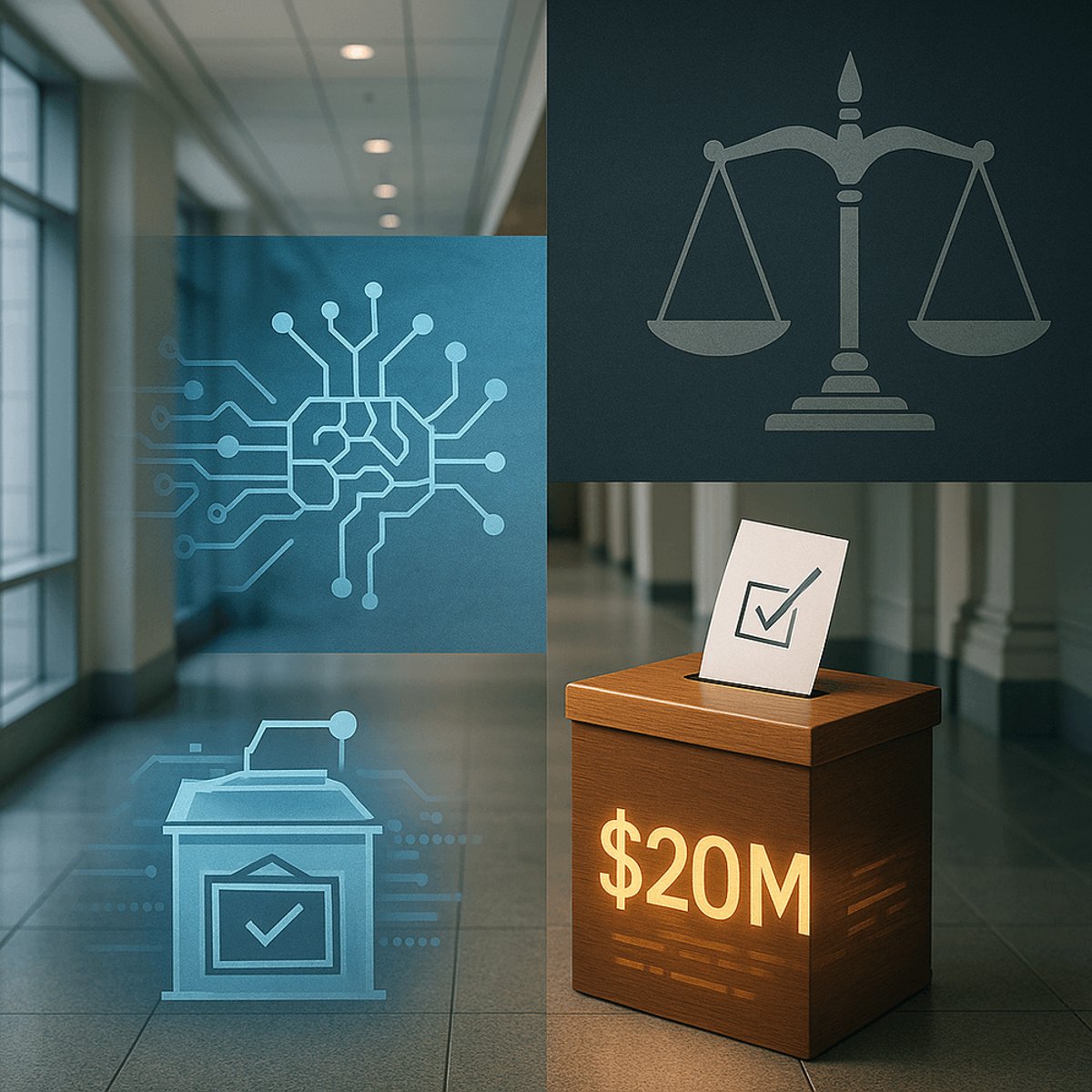
Anthropic just made one of the biggest political bets in AI history. The AI startup behind Claude is pumping $20 million into Public First Action, a newly formed political action committee dedicated to electing pro-regulation candidates in the 2026 midterms. The move sets up a direct showdown with deep-pocketed industry groups fighting to keep AI development largely unregulated, marking a rare split in Big Tech's typically unified lobbying front.
The AI industry's unified front on regulation just shattered. Anthropic, the AI safety-focused startup co-founded by former OpenAI executives, is betting $20 million that 2026's midterm elections will reshape how America regulates artificial intelligence. The company's massive donation to Public First Action represents one of the largest single political investments by any AI firm and puts it directly at odds with the broader tech industry's regulatory playbook.
Public First Action isn't your typical tech lobbying group. According to reports from CNBC, the PAC is explicitly targeting congressional races where candidates have staked out clear positions on AI oversight. The goal is simple but ambitious: flip enough seats to build a pro-regulation majority that could pass meaningful AI governance legislation before the technology races too far ahead of safeguards.
The timing isn't coincidental. With OpenAI reportedly preparing for a potential IPO and Google expanding its Gemini AI across consumer products, the window for establishing regulatory frameworks is closing fast. Anthropic's co-founder Dario Amodei has long argued that voluntary safety commitments aren't enough, and this $20 million war chest suggests the company is willing to put serious money behind that philosophy.
But Anthropic's move puts it in direct conflict with powerful industry forces. Multiple AI companies and tech giants have backed competing PACs that argue heavy regulation will cripple American innovation and hand the AI race to China. These groups have spent years building relationships with lawmakers, emphasizing the economic benefits of AI development and warning that premature regulation could strangle the technology in its crib.
The split reveals deep fault lines in how AI companies view existential risk versus competitive advantage. While Meta and others have pushed for open-source models and minimal restrictions, Anthropic has consistently advocated for what it calls "constitutional AI" - systems designed with built-in constraints and oversight mechanisms. That philosophical divide is now becoming a political battle with real consequences.
Public First Action's strategy appears focused on swing districts where AI policy hasn't yet become a partisan wedge issue. The PAC is likely targeting candidates who understand technology but aren't captured by industry lobbying, a narrow pool in a Congress where tech literacy remains disappointingly low. The $20 million gives them serious firepower for advertising, grassroots organizing, and opposition research in races that typically see far less outside spending.
The 2026 midterms arrive at a critical juncture for AI governance. The European Union has already implemented its AI Act, creating comprehensive rules around high-risk applications. China continues expanding its own AI regulatory framework focused on content control and national security. The U.S. remains caught between these approaches, with scattered state-level initiatives but no coherent federal strategy. Whoever controls Congress after 2026 will likely determine whether America adopts EU-style comprehensive regulation, maintains its current patchwork approach, or doubles down on industry self-governance.
Anthropics's political gambit also raises questions about the company's own competitive positioning. By advocating for regulations that could slow down rivals while potentially benefiting from its safety-first approach, Anthropic might be playing strategic hardball disguised as principled policy advocacy. Skeptics note that comprehensive AI regulations could create compliance moats that favor well-funded players like Anthropic while squeezing out smaller competitors and open-source alternatives.
The industry-backed PACs aren't sitting idle. Reports suggest they're preparing to match or exceed Anthropic's spending, setting up what could become one of the most expensive issue-focused campaign cycles in recent memory. The battle will play out in TV ads, digital campaigns, and town halls across competitive districts, with both sides framing the debate in starkly different terms: innovation versus safety, American competitiveness versus responsible development.
What happens in 2026 will echo for decades. The regulatory framework established in the next congressional term could determine whether AI development continues at breakneck speed with minimal oversight, or whether companies face mandatory safety testing, algorithmic auditing, and liability for harmful outputs. For Anthropic, $20 million is a relatively small price to potentially shape rules that will govern a trillion-dollar industry.
Anthropic's $20 million bet on AI regulation transforms the 2026 midterms into a referendum on how America governs its most consequential technology. This isn't just another lobbying campaign - it's a fundamental clash over whether innovation or safety should drive AI policy, backed by unprecedented political spending from within the industry itself. The outcome will determine if the U.S. follows Europe's comprehensive regulatory path, maintains its current hands-off approach, or charts an entirely new course. For voters in competitive districts, expect to hear a lot more about AI safety, Chinese competition, and algorithmic accountability over the next nine months. The future of AI governance won't be decided in Silicon Valley boardrooms - it'll be decided at ballot boxes across swing states.