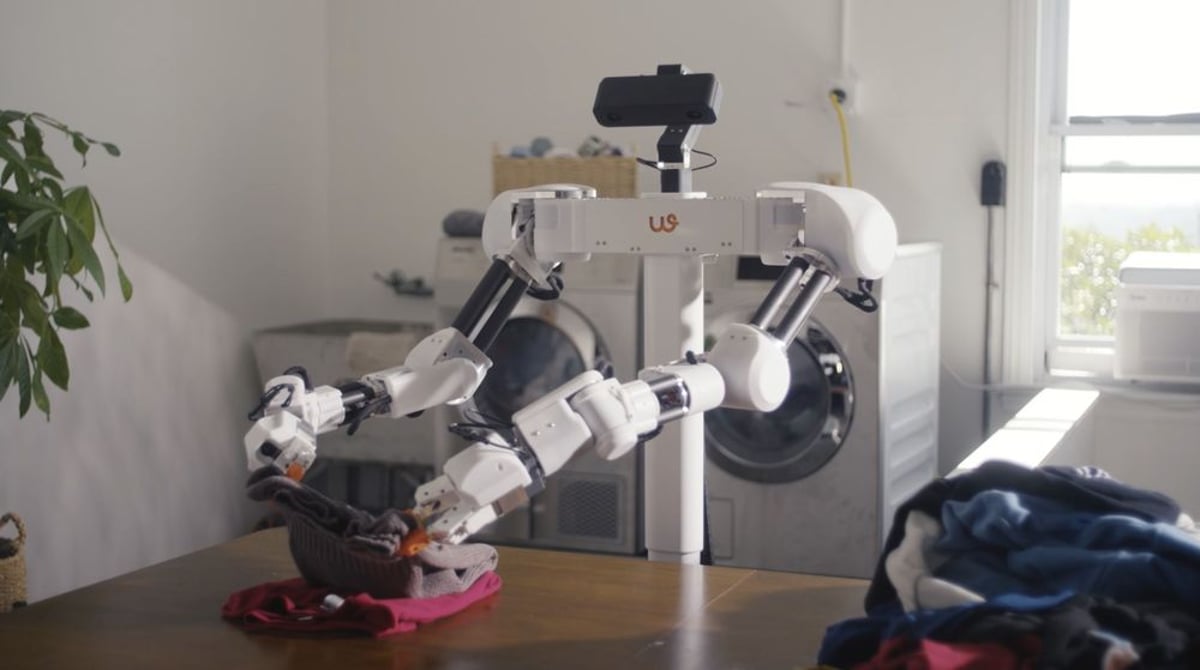
Weave Robotics just launched Isaac 0, an $7,999 laundry-folding robot that can't quite handle the job alone. The 18-month-old startup's first consumer product requires human teleoperators to assist with tricky folds, takes 30-90 minutes per load, and won't touch bed sheets, blankets, or inside-out clothes. It's a revealing glimpse at how far home robotics still has to go - and how startups are betting on iteration over perfection.
Weave Robotics is betting that Americans hate folding laundry enough to drop nearly eight grand on a robot that can't really do it alone. The Bay Area startup just opened reservations for Isaac 0, a stationary home robot with one job: folding your clothes while humans watch from afar, ready to jump in when things get complicated.
The pitch is straightforward. For $7,999 plus a $250 deposit, Bay Area residents get a plug-in folding station that tackles basic garments in 30 to 90 minutes per load. But the fine print tells a more interesting story about where consumer robotics actually stands in 2026. Isaac 0 won't touch large blankets, bed sheets, or anything turned inside-out, according to Weave's announcement. More revealing: it's not fully autonomous. The company stations teleoperators on standby to assist with trickier folds remotely.
That human-in-the-loop approach puts Isaac 0 in the same category as early self-driving car deployments - promising eventual autonomy while relying on remote safety drivers. It's a pragmatic strategy that lets Weave ship hardware now while the AI catches up. The company says performance will improve over time, suggesting Isaac 0 is as much a data collection device as a finished product.
The timing reflects broader momentum in home robotics. While companies like Tesla tease humanoid robots and Amazon experiments with warehouse bots, the path to useful home automation keeps hitting the same wall: manipulation of soft, unpredictable objects. Folding laundry is deceptively hard. Each fabric type behaves differently, clothes tangle and overlap, and identifying garment boundaries challenges even sophisticated computer vision systems.
Weave's approach - building a single-purpose stationary device instead of a mobile humanoid - sidesteps some complexity. Isaac 0 doesn't need to navigate rooms, climb stairs, or switch between tasks. But it still has to handle the core manipulation challenge, and the need for teleoperators shows that problem isn't solved.
The $7,999 price tag positions Isaac 0 as a luxury gadget, not a mass-market appliance. That's likely intentional. Early adopters fund further development while Weave works toward the autonomy and cost structure needed to reach mainstream consumers. It's the classic hardware startup playbook: ship to enthusiasts first, scale later.
What makes this launch notable isn't the technology - it's the transparency. By openly acknowledging Isaac 0's limitations and the role of human operators, Weave is setting realistic expectations in an industry prone to overpromising. Compare that to the parade of robotics demos that show cherry-picked successes while hiding failure rates.
The Bay Area-only rollout also signals caution. Limiting initial deployment to a concentrated geographic area makes supporting those teleoperators more practical and lets Weave iterate based on real-world feedback before expanding. It's a test bed, not a nationwide launch.
For context, other companies have tried solving the laundry problem. FoldiMate raised millions before shutting down without shipping. Samsung and LG have shown prototype folding machines at trade shows but haven't committed to consumer releases. The graveyard of laundry robotics startups suggests the technical and economic challenges are genuine.
Weave's investors are betting the company can push through where others stalled. The startup is 18 months old, which means it's likely raised seed funding and is using this launch to prove traction for a Series A round. Shipping hardware, even limited hardware, gives investors something tangible to evaluate beyond pitch decks and prototypes.
The teleoperator model also hints at a possible business pivot. If autonomous folding proves too difficult to perfect, Weave could shift toward a service model where remote operators become a permanent feature. That would change the unit economics entirely, turning Isaac 0 from a one-time purchase into a subscription service with ongoing labor costs.
What Isaac 0 really represents is the current state of home robotics: ambitious goals, incremental progress, and creative workarounds for technical limitations. The robot can't fold sheets or fix inside-out shirts. It needs human backup for complex tasks. But it exists, it ships, and people can actually buy it. That's further than most robotics startups get.
Isaac 0 won't revolutionize your laundry routine, but it might signal where home robotics is headed - imperfect products that ship now instead of perfect vaporware that never arrives. Weave is making a calculated bet that early adopters will pay premium prices for limited functionality if it means getting robots into homes where they can learn and improve. Whether that strategy works depends on how quickly the company can reduce its reliance on human teleoperators and expand beyond basic garments. For now, Isaac 0 is less a finished product than a very expensive beta test with customer-funded R&D. The question isn't whether it can fold your laundry today - it's whether buying one helps Weave build the robot that eventually can.