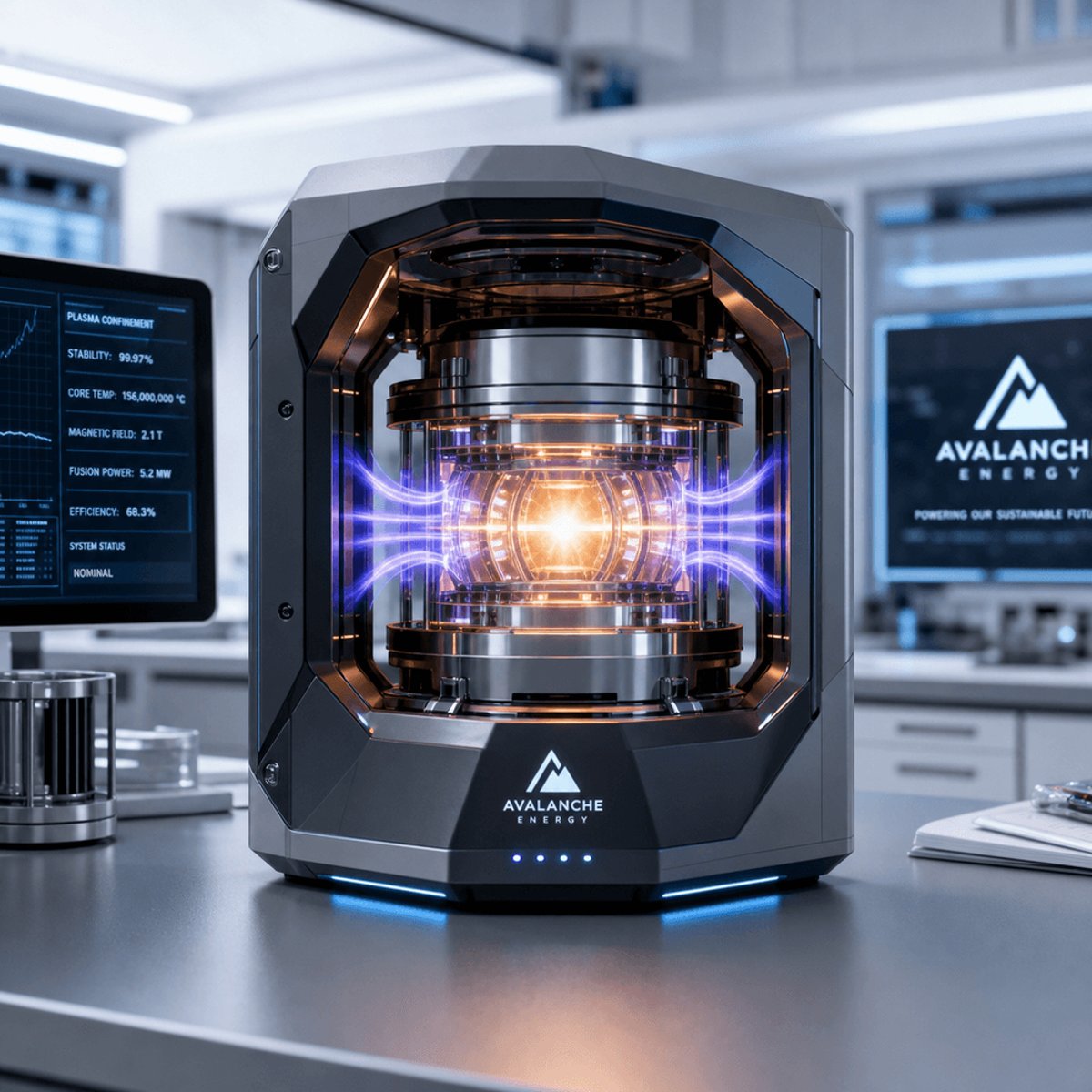
Avalanche Energy just crossed a major threshold in the race to viable fusion power. The Seattle-based startup announced its desktop-sized reactor prototype heated plasma to over 10 million degrees Celsius, a temperature hot enough to sustain fusion reactions. The breakthrough, reported exclusively by TechCrunch, marks a significant step for the company's unconventional approach to fusion energy - one that fits on a desk rather than filling a warehouse.
Avalanche Energy is making fusion power look surprisingly compact. The startup's latest prototype reached plasma temperatures north of 10 million degrees Celsius - roughly two-thirds the temperature at the sun's core - all within a device that could sit on your desk.
The announcement comes as fusion startups race to prove their competing approaches can deliver on decades of promises. While industry giants like Commonwealth Fusion Systems and TAE Technologies pursue tokamak and beam-driven designs requiring massive facilities, Avalanche is betting on a fundamentally different architecture that prioritizes miniaturization.
Reaching 10 million degrees matters because fusion reactions require extreme temperatures to overcome the electromagnetic repulsion between atomic nuclei. The sun achieves fusion at around 15 million degrees Celsius. Commercial fusion reactors will likely need to hit 100 million degrees or more to generate net energy gain, but today's milestone demonstrates Avalanche's core technology can create the plasma conditions necessary for fusion.
The company's approach centers on what it calls an "orbitrap" design - using electric and magnetic fields to confine plasma in ways that don't require the superconducting magnets and massive infrastructure of traditional tokamaks. This architectural choice allows for dramatically smaller reactors, potentially opening fusion power to applications beyond grid-scale power plants.
Avalanche raised $5 million in seed funding in 2022 and has since been methodically proving out its technology away from the spotlight. The company emerged from stealth with bold claims about desktop-scale fusion, drawing skepticism from fusion veterans accustomed to stadium-sized experiments. But the plasma temperature achievement suggests the physics might actually work at small scales.
The broader fusion landscape has transformed dramatically over the past few years. Commonwealth Fusion Systems raised over $2 billion and aims to demonstrate net energy gain by 2025. Helion Energy secured a power purchase agreement with Microsoft to deliver fusion electricity by 2028. The National Ignition Facility achieved fusion ignition in December 2022, proving net energy gain is physically possible.
But Avalanche's desktop form factor opens different possibilities. If the company can achieve net energy gain at small scales, the reactors could potentially be mass-produced and deployed in distributed configurations rather than requiring massive central facilities. That's still a big "if" - the startup needs to demonstrate not just high temperatures but sustained confinement and net energy output.
The 10 million degree milestone also doesn't tell us everything about the plasma's quality. Duration, density, and confinement time all matter as much as temperature for achieving fusion. The company hasn't disclosed how long it sustained these temperatures or what plasma densities it achieved.
Still, reaching this temperature threshold in such a compact device represents genuine technical progress. Most fusion experiments that hit comparable temperatures do so in reactors measured in meters, not inches. If Avalanche can scale up the performance while maintaining the small form factor, it could reshape assumptions about what fusion reactors need to look like.
The company faces the same fundamental challenge as every fusion startup: demonstrating Q>1, where the reactor produces more energy than it consumes. Temperature is just one variable in that equation. But by proving their compact approach can create fusion-relevant plasma conditions, Avalanche just moved from theoretical concept to experimental reality.
Avalanche Energy's temperature milestone won't immediately change the fusion timeline - we're still years away from commercial fusion power regardless of which technology wins. But it does validate that dramatically smaller reactor designs can create the extreme conditions fusion requires. If the company can maintain these temperatures while improving confinement and demonstrating net energy gain, the desktop form factor could make fusion accessible in ways that warehouse-sized tokamaks never could. For now, Avalanche just proved its unconventional bet on miniaturization can produce fusion-relevant plasma. The harder question is whether it can produce power.