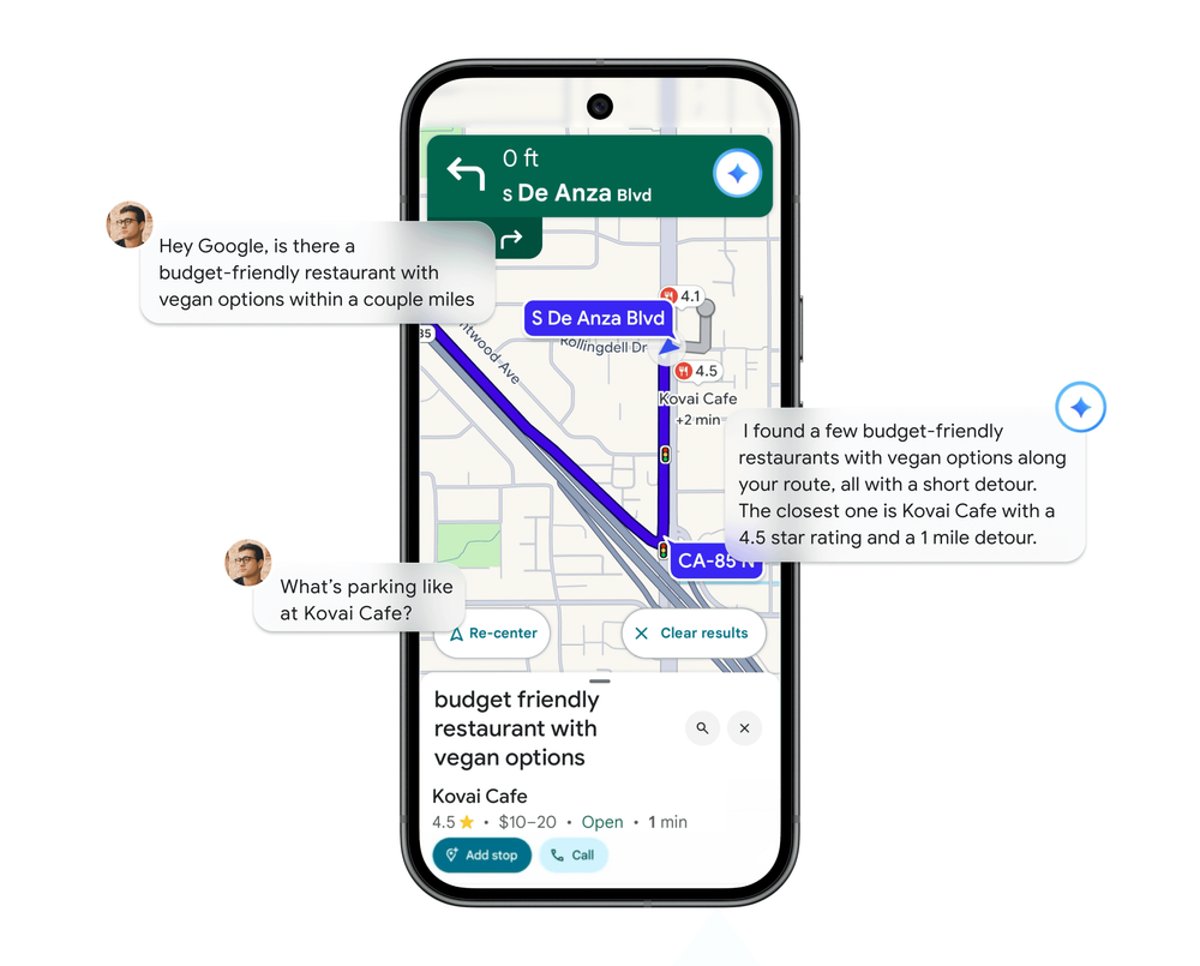
Google just transformed Maps from a simple navigation tool into an AI-powered copilot. The company's rolling out deep Gemini integration across core features like route planning, traffic alerts, and voice navigation - fundamentally changing how billions navigate daily. This isn't just another AI feature; it's Google reimagining the most-used mapping service on the planet.
Google just made every other navigation app look ancient. The search giant's rolling out comprehensive Gemini AI integration across Maps' core functions, turning basic point-A-to-B directions into conversational travel planning that feels like having a local expert riding shotgun.
The transformation goes deep into Maps DNA. Users can now ask open-ended questions while driving - "Find me good Thai food along this route" or "Add a gas station stop before my meeting" - and watch Gemini dynamically adjust navigation in real-time. "We've often envisioned navigating with Maps as being your all-knowing copilot," Google Maps product director Amanda Moore told reporters, "giving you exactly the information you need when you need it and taking the stress out of getting from A to B."
But Google's betting on more than just voice commands. The company's leveraging Gemini's ability to process billions of Street View images, cross-referencing them against 250 million logged locations to deliver contextual, landmark-based directions. Instead of "turn left in 500 feet," drivers hear "turn left at the Starbucks" - a fundamental shift that makes navigation feel more human.
The competitive implications ripple immediately across the mapping landscape. While Apple focuses on privacy-first navigation and startups like Waze (ironically, Google-owned) emphasize community-driven traffic data, Google's doubling down on AI sophistication. "It's connecting the dots between trusted information from the web, reviews from the Maps community, and all the rich geospatial data that Maps has," Vishal Dutta, group product manager for Google Maps, explained. "And then Gemini pulls it all together with its summarization capabilities into one clear, helpful answer you can act on instantly while you're on the go."
The integration extends beyond navigation into proactive intelligence. Gemini now monitors familiar routes in the background, automatically alerting users to crashes, construction, or closures before they even open Maps. This addresses a key friction point - most people don't check traffic for routine commutes until it's too late to reroute effectively.
Google's also embedding cross-app functionality that feels genuinely useful rather than gimmicky. During navigation, users can ask Gemini to add Calendar reminders, summarize emails, or pull recent news updates - all without leaving the Maps interface. The company's betting that contextual AI assistance during travel represents a massive opportunity to deepen user engagement across its ecosystem.
The elephant in the room remains AI hallucinations. Navigation errors aren't just inconvenient - they're potentially dangerous. Google's addressing this by grounding Gemini's responses in verified location data rather than allowing free-form generation. "We've also really worked to ground this in our place information," Moore emphasized. "So when you ask for places on your route, it's using the actual place information in the real world. So there should be no hallucinations on places to stop at or things like that."
The technical architecture reveals Google's broader AI strategy. By embedding Gemini directly into Maps rather than building a separate assistant layer, the company's creating seamless experiences that feel native rather than bolted-on. This approach mirrors successful integrations across Gmail, Search, and Photos - products where AI enhancement feels evolutionary rather than disruptive.
Market timing couldn't be better for Google. As competitors struggle with AI implementation costs and accuracy concerns, Google leverages existing infrastructure - Street View imagery, location databases, user review systems - to deliver immediately practical AI features. The company's essentially turning years of mapping investment into an AI moat.
The rollout strategy reflects lessons learned from previous AI launches. Rather than a splashy global announcement, Google's gradually deploying features across Android, iOS, and built-in vehicle systems. This measured approach allows for real-world testing and refinement before millions encounter potential issues during critical navigation moments.
Google's Gemini integration represents more than incremental improvement - it's a fundamental reimagining of how navigation works. By combining conversational AI with billions of real-world data points, Google's creating experiences that feel less like following robotic directions and more like getting advice from a knowledgeable local friend. For the navigation market, this sets a new baseline that competitors will struggle to match without similar AI infrastructure and data advantages. The real test comes as millions of daily commuters discover whether AI-powered navigation delivers on its promise or creates new frustrations on familiar routes.