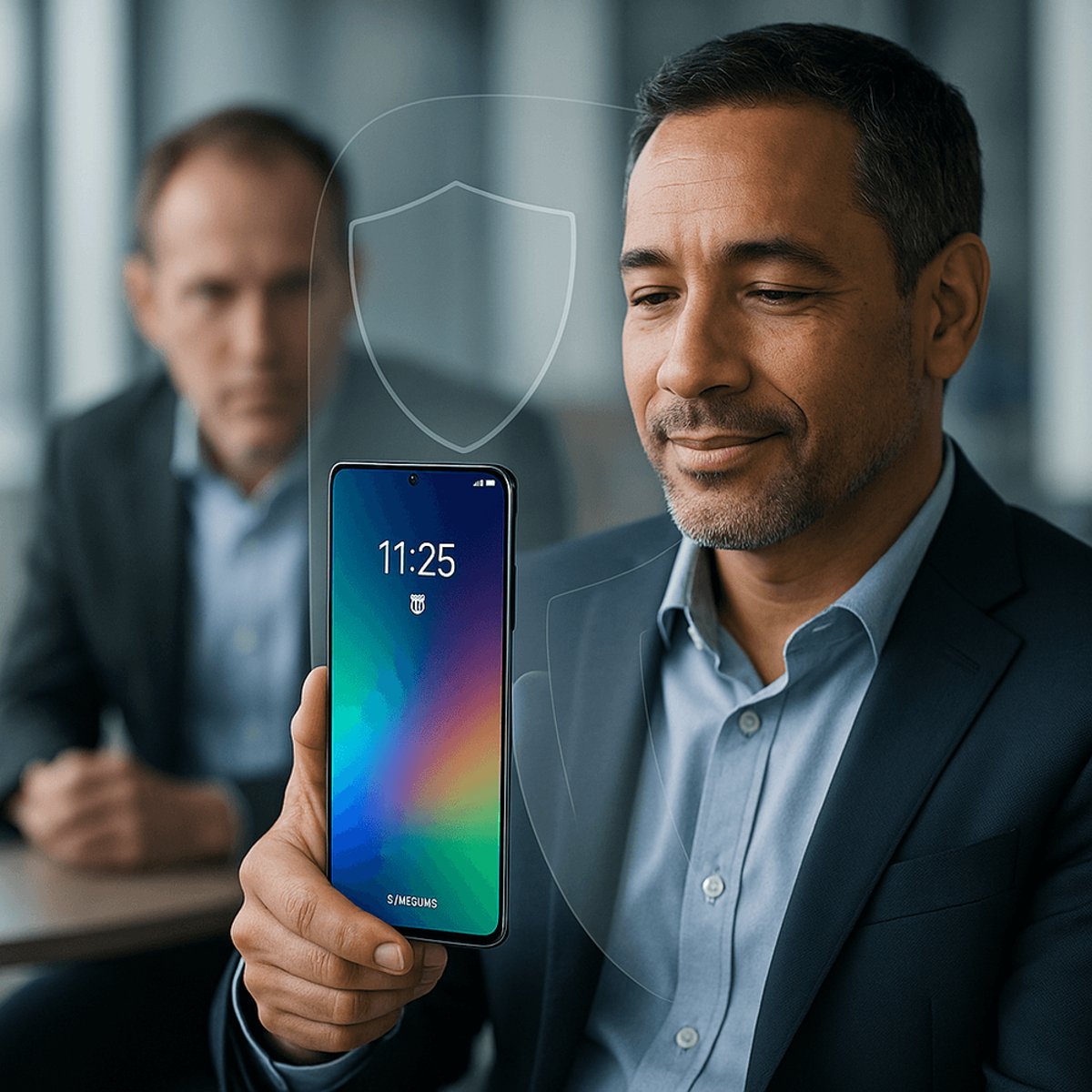
Samsung just teased a major privacy play that's been half a decade in the making. The company's about to roll out a new display technology that blocks shoulder surfers from peeking at your screen in public spaces, with customizable settings that let you control exactly what stays private. After five years of engineering and real-world testing, the feature represents what Samsung's calling "privacy at a pixel level" - and it's landing on Galaxy devices soon, likely at the upcoming Unpacked event.
Samsung is taking a swing at one of mobile's most persistent privacy problems: the stranger reading your texts over your shoulder on the subway. The company just announced it's rolling out a new display technology that actively prevents visual hacking, and it's not just a software filter - it's a hardware-software fusion that took five years to perfect.
The tech addresses what Samsung calls "shoulder surfing," that uncomfortable moment when you realize someone's eyeing your screen while you're typing a password or checking a sensitive message. According to Samsung's announcement, the feature gives users granular control over what stays private, letting them shield specific apps or lock down notification previews that flash across the screen in public.
What makes this different from existing privacy screens is the flexibility. You're not stuck with an all-or-nothing approach. Samsung says users can dial protection up or down based on context - maybe you want full privacy for banking apps but don't care if someone glimpses your weather widget. The system lets you customize visibility settings and choose which parts of your experience stay hidden.
Samsung hasn't fully detailed the underlying technology, but the company emphasizes it's both hardware and software working together, "calibrated to protect you without getting in your way." That suggests it's likely integrated into the display panel itself, possibly using viewing angle restrictions or dynamic pixel-level adjustments that degrade visibility from side angles while keeping the screen crisp for the person holding the phone.
The development timeline is notable. Five years of engineering means Samsung started this project around 2021, long before current AI privacy concerns dominated headlines. The company says it studied how people actually use their phones, what they consider sensitive, and how security features should feel in daily life. That user research approach likely informed the customization options - recognizing that a blanket privacy mode would frustrate users who don't need protection 24/7.
This fits into Samsung's broader security narrative. The company's been pushing Samsung Knox as a comprehensive defense platform for over a decade, with hardware-level protections like Knox Vault (which isolates sensitive data in a secure processor) and Knox Matrix (which creates a private blockchain across your Samsung devices to monitor for threats). "There is no privacy without strong security," Samsung states in the announcement, positioning this display tech as the visual layer on top of that foundation.
The timing strongly suggests this'll debut at Samsung's next Galaxy Unpacked event. The company's teasing videos and the "coming very soon" language point to an imminent flagship launch, likely the Galaxy S26 series or potentially the next foldable generation. Samsung's made privacy a key selling point for Galaxy AI features, and this hardware addition gives the company a tangible differentiator against Apple and Google in the premium phone space.
From a competitive standpoint, this could force other manufacturers to respond. Privacy screens have existed as third-party accessories for years, but baking the functionality into the display itself at the OS level is a different game. If Samsung can deliver this without compromising display quality or battery life - two big ifs - it becomes a checkbox feature that rivals will need to match.
The announcement also touches on notification privacy, which has been a growing concern as lock screen previews become more detailed. Being able to blur or hide notification content when someone's nearby addresses a real pain point, especially for professionals who handle sensitive information on mobile devices.
What Samsung isn't saying yet is whether this'll be exclusive to certain models or tier across the Galaxy lineup, what the performance impact looks like, or how the system determines when to activate protection. Those details will matter for real-world usability. A feature that requires manual toggling every time you board a train won't get used. But if Samsung's cracked automatic context awareness - say, using the front camera to detect when someone's at the wrong viewing angle - that'd be genuinely useful.
The company's framing this as "privacy you can see and security you can feel," which suggests there'll be a visible interface element showing when protection is active. That's smart UX design - users need to know the feature's working without it being intrusive.
For Samsung, this is another piece of the Knox ecosystem puzzle. The company's been methodically building a security story that spans hardware, software, and now the actual display output. In an era where phones hold increasingly sensitive AI-processed personal data, being able to physically shield that information from prying eyes becomes more than a nice-to-have.
Samsung's betting that physical privacy protection will resonate in a market increasingly anxious about data security. The five-year development cycle shows this isn't a rushed response to market trends but a calculated hardware play that could differentiate Galaxy devices in a crowded premium space. If the execution matches the promise - seamless, customizable, and actually useful in daily scenarios - this could set a new baseline for mobile privacy features. The real test comes when we see how it performs in actual crowded spaces and whether it compromises the display experience Samsung's known for. Watch for the full reveal at the next Unpacked event, where Samsung will need to prove this isn't just a clever tech demo but a feature people will actually use.