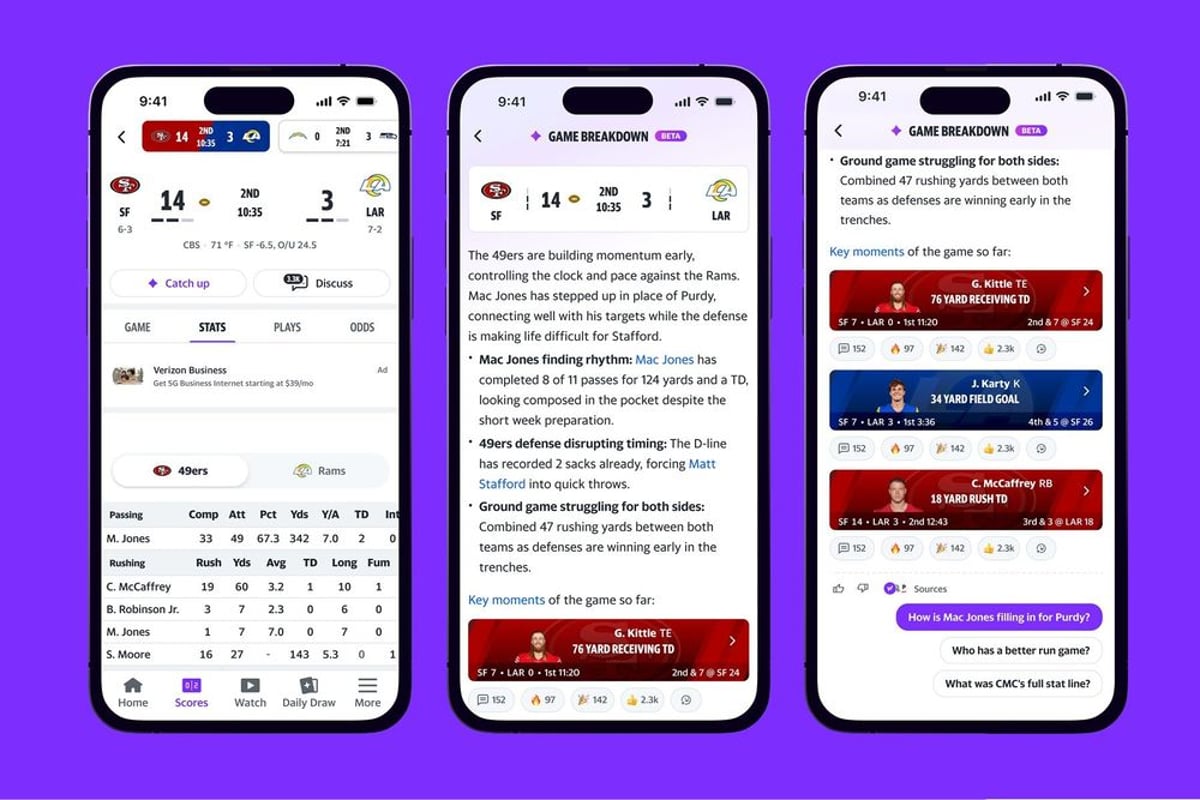
Yahoo Sports is betting AI can do what human writers have done for decades - capture the drama and storylines of NFL games as they unfold. The company just launched Game Breakdowns, an AI-powered feature that generates real-time game summaries, key plays, and follow-up prompts for Fantasy Plus subscribers during this week's NFL action.
Yahoo is making its move in the AI sports content race, launching Game Breakdowns just as Week 14 of the NFL season kicks into high gear. The feature, currently rolling out in beta to Yahoo's Fantasy Plus subscribers, promises to automatically capture the stories and stats that matter most about any game - before, during, and after it's played.
The timing couldn't be better. With playoff implications heating up across the league, Yahoo's betting that AI can distill the chaos of live football into digestible insights that fantasy players and casual fans actually want to read. "What are the things people would want to know that are not obvious?" Andrew Machado, head of product for Yahoo Sports, told The Verge in a recent demo.
Game Breakdowns consists of three core components that update constantly as games progress. First, there's an AI-generated game summary designed to go beyond typical box-score statistics and capture the most compelling storylines. Second, a running feed of important plays helps users catch up on crucial moments they might have missed. Finally, a "Prompts" section offers suggested follow-up questions about the game's key developments, though users can't yet write their own queries.
The approach puts Yahoo in direct competition with ESPN and the Associated Press, both of which have been experimenting with AI-generated sports content for months. But Yahoo's trying to push beyond the formulaic recaps that have defined early AI sports writing. In Machado's demonstration, one game preview included injury updates crucial for fantasy players alongside historical context about both teams' offensive capabilities.
The challenge, as Machado admits, is that AI excels at mining statistics but often misses the emotional, human elements that make sports compelling. One example he showed captured plenty of interesting stats but completely overlooked a much-anticipated player debut that dominated fan discussion. To address this gap, Yahoo plans to lean on both its own journalists and user feedback to train the AI about what really matters to sports fans.
The system tries to bridge this gap by monitoring social signals in real time. "We've got all the signals of reactions, and we've got all the signals of win percentage change," Machado explained. "We're just homing through the box score and slamming it all together into this." The AI identifies key plays partly by analyzing what commenters discuss during games, creating a feedback loop between fan engagement and automated content.
For now, the feature remains locked behind Yahoo's Fantasy Plus paywall, but the company has bigger ambitions. Machado says Yahoo plans to expand Game Breakdowns to other sports and eventually personalize the content for individual users. Future versions could tailor summaries based on your favorite players, fantasy team roster, or personal interests - though the current iteration seems particularly fond of obscure historical comparisons and betting lines.
The move reflects Yahoo's broader strategy to differentiate its sports app in an increasingly crowded market. While Google and Apple offer basic sports scores, and Meta pushes sports content through its social feeds, Yahoo's betting that AI-powered analysis can create sticky, premium content worth paying for.
Yahoo's Game Breakdowns represents the latest attempt to solve sports media's automation puzzle - how to capture the drama and nuance that makes games worth watching. While the technology shows promise for handling statistics and basic play-by-play, the real test will be whether AI can learn to recognize the human stories that turn casual viewers into passionate fans. With Fantasy Plus subscribers as guinea pigs, Yahoo's about to find out if artificial intelligence can truly understand what makes sports compelling.