Asus just raised the bar for dual-screen laptops. The 2026 Zenbook Duo packs Intel's new Panther Lake chip into a redesigned dual-OLED chassis that finally makes portable multi-monitor setups practical. With 14+ hour battery life and a $2,300 price tag that's $500 more than last year's model, the Duo is betting professionals will pay premium for seamless screen-switching anywhere. Early testing shows the gamble might pay off - this thing's a productivity beast.
Asus is doubling down on dual-screen laptops with the 2026 Zenbook Duo, and this time the execution feels nearly flawless. The company just unveiled a refined version of its productivity powerhouse that addresses most of the quirks that plagued earlier models - while introducing Intel's brand-new Panther Lake architecture to the mix.
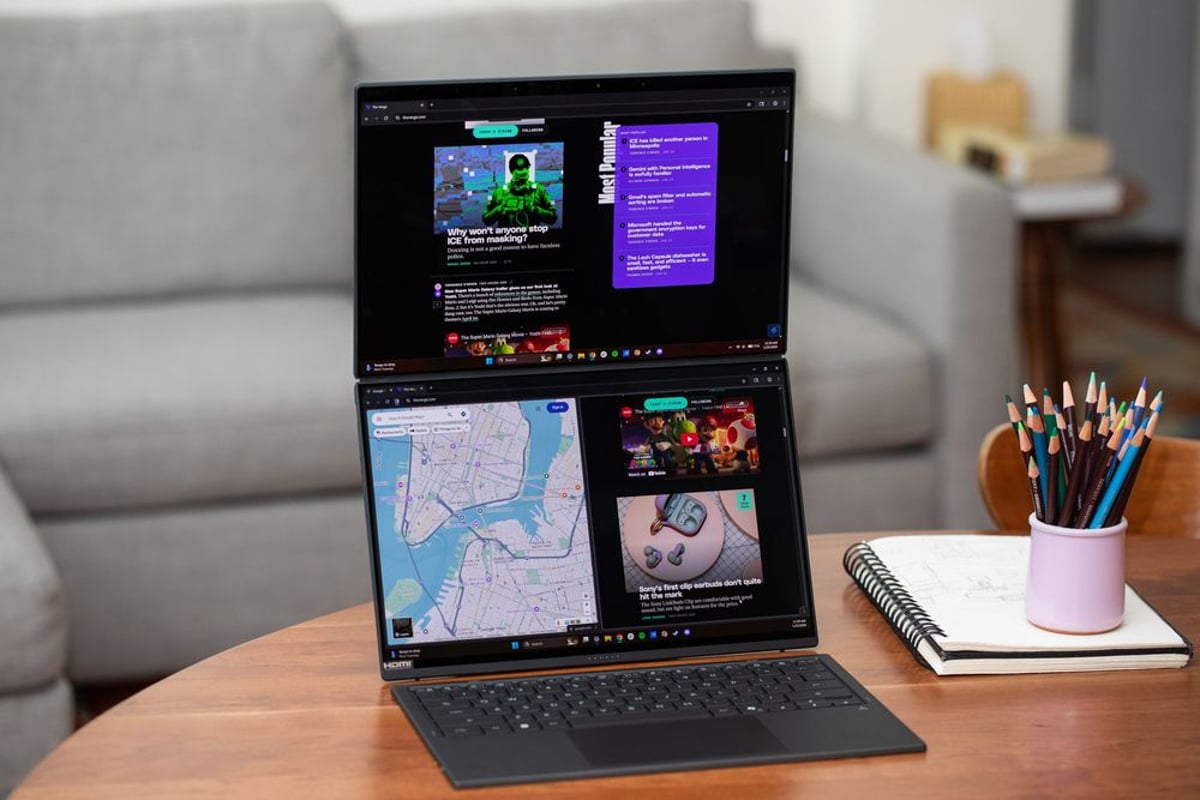
The headline changes start with the hinge. Asus redesigned how the twin 14-inch OLED displays connect, bringing them closer together on a single plane for what The Verge describes as "a more seamless look" compared to previous iterations. Both screens run at 2880 x 1800 resolution with 144Hz refresh rates, and the gap between them has shrunk enough that working across both panels feels less like juggling two devices and more like using one continuous workspace.
But the real story here is what's under the hood. The Zenbook Duo is one of the first laptops shipping with Intel's Core Ultra X9 388H processor - part of the Panther Lake generation that Intel's been positioning as its comeback play against Apple Silicon. According to testing, this chip doesn't disappoint. The Duo "can handle heavy multitasking, breeze through content creation in Adobe apps, and even play games well in 1080p / 1200p resolution," per the review. More impressively, it delivers near-full performance even when unplugged - something Windows laptops have historically struggled with.
That unplugged performance matters because Asus stuffed a massive 99Wh battery into this thing. The result? Over 14 hours in standard rundown tests, with six-hour stretches of dual-screen use at 80% brightness while running multiple Chrome tabs, virtual desktops, and Spotify. The reviewer notes the laptop went from full charge to 24% during that marathon session - suggesting the Duo can legitimately handle a full workday without hunting for outlets.
The design itself got smarter too. The detachable keyboard deck - which houses both keyboard and mechanical trackpad - now connects via magnetic pogo pins and works wirelessly over Bluetooth for a claimed 11.6 hours. You can charge it separately via USB-C or just snap it back onto the laptop to top it up. The 1.7mm key travel feels "decently tactile," though the trackpad's edge gestures proved annoying enough to disable in Asus' MyAsus app.
Where the Zenbook Duo pulls ahead of competitors like the Lenovo Yoga Book 9i is in the details. The built-in kickstand eliminates Lenovo's magnetic folio case. The keyboard includes a trackpad, unlike Lenovo's solution that requires a separate mouse. And you can actually close the Duo with the keyboard inside, making it far more packable. Port selection is better too - two Thunderbolt 4 USB-C ports, full-size HDMI 2.1, USB-A 3.2 Gen 2, and a 3.5mm jack. The Lenovo can't match that variety.
The tradeoffs? At 3.65 pounds and nearly an inch thick at the hinge, this is a chunky 14-inch laptop. It's only a tenth of a pound heavier than Apple's M5 MacBook Pro, but it's noticeably thicker. The vertical orientation that makes dual-screen work so well for side-by-side documents also blocks ports when you rest the laptop on its side - meaning you might lose access to USB-A or HDMI depending on which way you lean it. Half the six-speaker array gets muffled in that position too, making music sound "unbalanced and a little odd."
And there are software quirks. Windows 11 requires manually switching which display is primary when you rotate the laptop to keep the System Tray where it belongs. Asus' ScreenXpert overlay software tries to help with dual-screen management - launching grouped apps across both panels, for instance - but it's "still clunky and limited in scope." The multi-finger touch gestures for virtual keyboard and trackpad controls are easy to forget or accidentally trigger.
None of that derails the core experience though. Having two perfectly matched 14-inch OLEDs available anywhere turns out to be incredibly useful for actual work. Tiling apps across vertical screens, referencing documents side-by-side, or just getting a better webcam angle that's closer to eye level - these are real productivity gains, not gimmicks. The reviewer notes switching between clamshell mode and dual-screen mode "as quickly as you can rip the keyboard deck from its magnetic pogo pins and deploy the built-in kickstand."
The pricing is where things get interesting. At $2,299.99 for the Core Ultra X9 388H config with 32GB RAM and 1TB storage, the 2026 Zenbook Duo costs $500 more than last year's model with similar specs. That's a steep jump, though you're getting Intel's latest silicon and longer battery life. Asus plans to launch a cheaper version later this year with last-gen Arrow Lake H chips, which might ease the sticker shock.
The company's also bringing the dual-screen concept to gaming with the ROG Zephyrus Duo, announced at CES 2026. That suggests Asus sees enough demand to expand beyond productivity users - though dual-screen laptops remain firmly niche for now. The Zenbook Duo ships sometime in Q1 2026, putting it on shelves within weeks.
What makes this generation feel different is that Asus finally nailed the fundamentals. The Ceraluminum coating looks and feels premium. The battery lasts all day. The performance doesn't force compromises. And the design solves most of the travel headaches that made earlier dual-screen laptops feel like science projects. The Verge review wraps with "Asus nailed most aspects of the Zenbook Duo, making it an easy recommendation."
For remote workers, content creators, or anyone who's ever wished their laptop had a second monitor, the 2026 Zenbook Duo makes a compelling case that dual screens shouldn't be as rare as they are. The question is whether $2,300 is the right price to prove it.
The 2026 Zenbook Duo represents Asus finally getting the dual-screen laptop formula right - combining Intel's new Panther Lake performance with genuine all-day battery life in a package that actually makes sense for travel. At $2,300 it's not cheap, and there are still quirks around port access and Windows multi-display management. But for anyone who's serious about productivity on the go, having two matched 14-inch OLEDs that deploy in seconds might be worth the premium. The real test will be whether the market agrees - or if dual-screen laptops remain a niche curiosity despite Asus proving they can work this well.