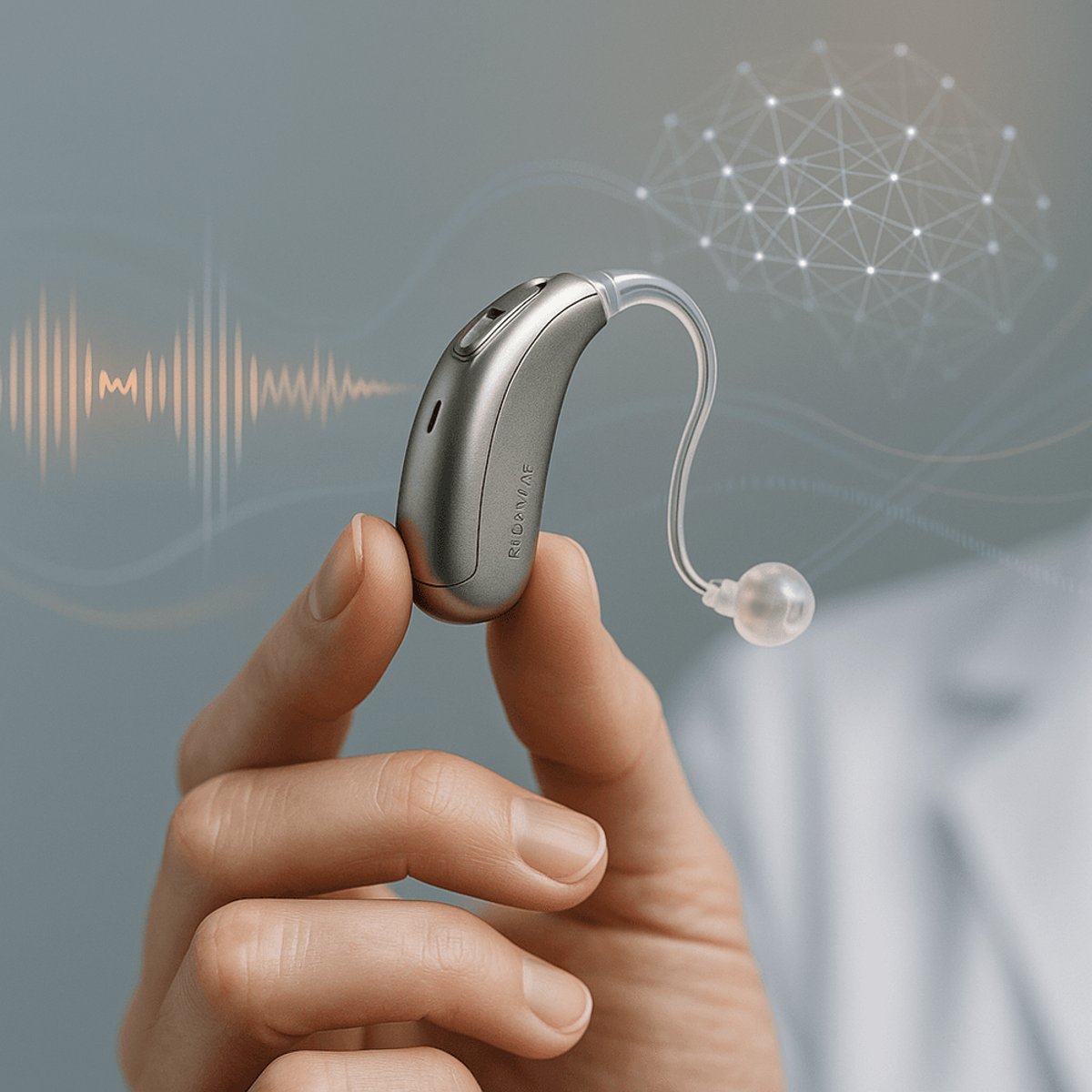
Phonak just launched the Audeo Infinio Ultra Sphere, a prescription hearing aid that breaks from industry norms by packing two processing chips instead of one. The Swiss company's flagship device pairs its older Era chip with a new DeepSonic deep neural network processor designed to isolate speech from background noise, no matter which direction voices come from. It's a bold hardware bet in a market where most competitors stick to single-chip designs, but the premium approach comes with trade-offs in size and performance consistency.
Phonak is making a counterintuitive gamble with its latest hearing aid. While the rest of the industry chases miniaturization, the Swiss manufacturer just released the Audeo Infinio Ultra Sphere - a behind-the-ear device that's deliberately bigger than its rivals, all in service of fitting two processors under the hood instead of one.
The naming might sound absurd ("Sphere" refers to spherical sound processing, not the product's teardrop shape), but the engineering rationale is straightforward. Phonak paired its 2024-era Era chip, which handles standard audio processing and wireless connectivity, with a brand-new DeepSonic DNN chip. That second processor runs deep neural network algorithms focused exclusively on one task: isolating human speech from ambient noise, regardless of where voices originate in a room.
Wired's Christopher Null spent a week testing the Ultra Sphere after professional fitting by a Phonak representative. His verdict reveals the promise and limitations of this dual-chip strategy. In noisy environments - restaurants, busy streets, crowded offices - the hearing aids delivered noticeable but not transformative noise suppression. Background din got dulled enough to improve conversation clarity, though Null notes it's "nearly impossible to quantify exactly how much better" the performance is compared to single-chip alternatives like the Jabra Enhance Select 700.
But the real surprise came in quiet settings. The Ultra Sphere exhibited an intermittent hissing sound that would appear for a few seconds, vanish, then return minutes later. The effect persisted throughout testing and only manifested when ambient noise dropped below a certain threshold. It suggests Phonak's noise-processing algorithms might be overcompensating in low-stimulus environments, essentially creating artifacts when there's nothing to suppress.
The physical trade-off is unavoidable. At 3.39 grams per unit, the Ultra Sphere is 31% heavier than the 2.58-gram Jabra and 26% heavier than the 2.68-gram Horizon Go 7IX. That translates to a visibly larger profile behind the ear, though Null reports no comfort issues during extended wear. Phonak clearly decided that users prioritizing speech clarity would accept the size premium.
The hardware design sticks to proven conventions otherwise. Both hearing aids feature two-way rocker buttons for power, volume, and media playback. Tap controls exist for Bluetooth functions but ship disabled by default in the MyPhonak app. IP68 weatherproofing matches what's standard across premium hearing aids, and buyers get seven color options. Phonak also offers its new wax-resistant EasyGuard ear domes alongside traditional open and closed tip styles, all fitted during the required professional evaluation.
The Infinio Ultra line includes a less expensive R model without the DeepSonic chip, effectively giving buyers a choice between proven single-processor performance and the experimental dual-chip approach. That product segmentation reveals Phonak's own hedging - the company isn't confident enough in DeepSonic to make it standard across the entire lineup.
What's missing from the review is pricing, battery life data, and direct A/B comparisons with competitors. Null received a professionally tuned unit, which means his experience reflects optimal configuration rather than out-of-box performance. It's also unclear whether the hissing artifact is a universal issue or specific to certain hearing loss profiles and tuning settings.
The dual-chip strategy puts Phonak in an interesting position against rivals. While companies like Jabra and Starkey optimize single processors for efficiency and size, Phonak is betting some users will trade discretion for computational power. The approach mirrors trends in consumer electronics, where flagship smartphones now routinely pack multiple specialized chips for AI, imaging, and connectivity.
But hearing aids aren't smartphones. Users wear them 12-16 hours daily, often in professional and social situations where visibility matters. The Ultra Sphere's larger profile might not bother someone prioritizing function over form, but it's a visible compromise in a category where "invisible" models increasingly dominate marketing.
The noise-processing performance also raises questions about diminishing returns. If the improvement is "mild" rather than dramatic, does the dual-chip complexity justify the size increase and potential software quirks? Phonak will need to demonstrate clearer performance gaps to convince audiologists and users that two chips beat one optimized processor.
What's certain is that the Ultra Sphere represents a different design philosophy. Instead of chasing incremental refinements to existing architectures, Phonak added dedicated silicon for a specific use case. Whether that pays off depends on how much users value speech clarity in noisy settings versus all-around performance and discretion.
Phonak's dual-chip gamble with the Ultra Sphere hearing aids illustrates the tension between specialized performance and all-around usability. The DeepSonic processor delivers measurable benefits in noisy environments, but the persistent hissing in quiet rooms and noticeably larger size raise questions about whether two chips genuinely outperform one well-optimized processor. For users who spend significant time in crowded, conversation-heavy settings, the trade-offs might make sense. But the hearing aid market increasingly rewards devices that disappear both physically and functionally, and the Ultra Sphere doesn't quite achieve that invisibility. The real test will come when audiologists start fitting these devices at scale and users report whether the speech clarity gains justify the compromises elsewhere.