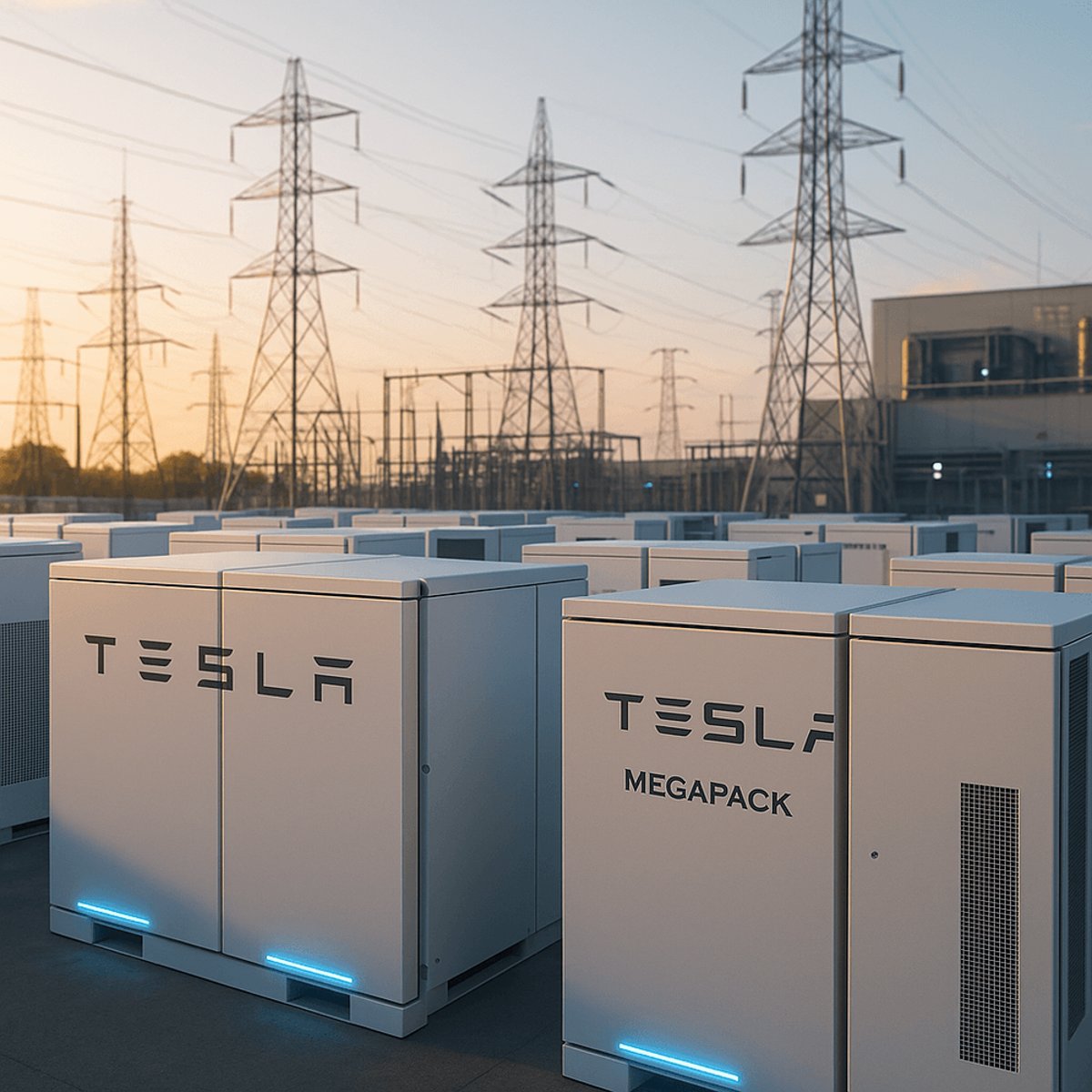
While Tesla's automotive business struggles through its worst year in recent memory, the company's energy storage division is quietly becoming its most profitable lifeline. The battery maker just posted a 48% jump in energy storage deployments, with products like the Megapack and Powerwall now driving nearly a quarter of Tesla's gross profit - and earning margins that are double what the company makes selling cars. It's a dramatic shift that's reshaping what Tesla actually is as a business.
Tesla's energy storage business just did something the company desperately needed - it saved a dismal earnings report from turning catastrophic. While the automaker's profit tumbled 45% compared with 2024, driven by collapsing electric vehicle sales, the battery storage division quietly delivered the kind of growth that used to define Tesla's automotive heyday.
The numbers tell a story of business transformation. Tesla deployed a record 46.7 gigawatt-hours of energy storage products in 2025, a 48% surge from the previous year, according to the company's official 10-K filing. That's not just incremental growth - it's the kind of hockey-stick trajectory that makes investors forget about declining car sales, at least temporarily.
But here's where it gets really interesting. Big stationary batteries like the Megapack and residential Powerwall units, along with solar installations, now drive nearly a quarter of Tesla's entire gross profit. Last quarter alone, the Megapack contributed $1.1 billion to the storage business's $3.8 billion in gross profit for the full year. Storage and energy generation revenues climbed 26.5% to $12.8 billion - a figure that's starting to look material even for a company of Tesla's size.
The margin story is even more compelling. These batteries and solar panels deliver a gross margin of 29.8%, nearly double what Tesla earns from its core automotive business. It's a stark reminder that sometimes the side project becomes more profitable than the main act. While Tesla's been busy slashing car prices to defend market share, its energy products have been quietly commanding premium economics.
The pipeline looks strong too. Large energy storage projects - the kind installed for utilities or data centers - tend to be milestone-based, with revenue recognized as projects hit specific benchmarks. In its SEC filing, Tesla revealed it expects to recognize $4.96 billion this year in deferred revenue from projects already underway. That's more than double what the company booked from storage projects in 2025, suggesting the deployment surge has runway.
But it's not all smooth sailing. The One Big Beautiful Bill Act, which recently passed Congress, phased out tax credits for residential energy storage systems like the Powerwall. Commercial installations - the Megapack and newer Megablock products - still qualify for tax credits through the mid-2030s, but the residential headwind will sting. Tariffs and other OBBBA provisions also threaten to push battery cell prices higher, the company acknowledged in its filing.
There's another wrinkle. Sales volumes were up sharply, but the average selling price of a Megapack actually declined, according to Tesla's disclosures. That suggests competition in the energy storage market is intensifying, with players like Fluence Energy and traditional power equipment manufacturers pushing into the space. Tesla may be growing fast, but it's not growing unopposed.
Still, the company remains bullish on where this business is headed. The explosion in AI infrastructure is creating unprecedented demand for grid stability and backup power, particularly around data centers that can't afford even brief outages. "Despite these challenges, as AI infrastructure drives rapid load growth, we see opportunities for our energy storage products to stabilize the grid, shift energy when it is needed most and provide additional power capacity," Tesla said in its earnings report.
That positioning around AI infrastructure is smart. Data centers are power-hungry beasts, and the build-out happening across the country is straining grids in key markets. Energy storage systems that can smooth demand peaks and provide backup capacity are becoming must-have infrastructure, not nice-to-have add-ons. Tesla's scale in battery manufacturing gives it a structural advantage in a market that's suddenly moving from niche to essential.
The timing couldn't be better for Tesla's narrative. With automotive margins under pressure and EV growth slowing industry-wide, having a high-margin, fast-growing business unit provides cover - and optionality. It's the kind of diversification Wall Street has been hoping to see from Tesla for years, even if it took a crisis in the core business to make it obvious.
What's emerging is a very different Tesla than the pure-play EV maker investors signed up for. Energy storage is no longer a side project or a rounding error - it's becoming a pillar of the business with economics that might eventually rival or surpass automotive. The question now is whether this growth can continue at anywhere near the current pace, or if 2025 was a peak year driven by one-time factors and pent-up demand.
Tesla's energy storage surge represents more than just a bright spot in an otherwise challenging earnings report - it's a fundamental rerating of what the company's business model might look like in five years. With 48% growth, margins double those of automotive, and a $5 billion revenue pipeline already locked in, the battery storage division is proving that Tesla's expertise in battery technology and manufacturing scale can create value well beyond electric vehicles. The AI infrastructure boom and grid modernization tailwinds suggest this isn't a one-year blip. But with residential tax credits disappearing, competition intensifying, and average selling prices declining, the real test will be whether Tesla can maintain these growth rates while protecting margins. For now, though, Megapacks and Powerwalls are doing what the Cybertruck and Model 3 can't - delivering the growth story investors are desperate to hear.