Samsung just dropped three new AI-powered kitchen appliances that signal the company's push deeper into the premium smart home market. The Bespoke AI Single 1Door Fridge & Freezer, Bespoke AI Dishwasher, and Extractor Induction Hob blend AI-driven performance with seamless design integration. "We're strengthening Samsung's position in the premium kitchen by combining seamless design with purposeful intelligence," Hyoung Min Park, VP and Head of Customer Experience for Samsung's Digital Appliances division, told Samsung Newsroom.
Samsung is making a calculated bet on AI-powered kitchen appliances as the battleground for premium smart home dominance. The company's latest Bespoke lineup—unveiled today—brings three new appliances engineered to blend into modern kitchens while delivering what Samsung calls "purposeful intelligence."
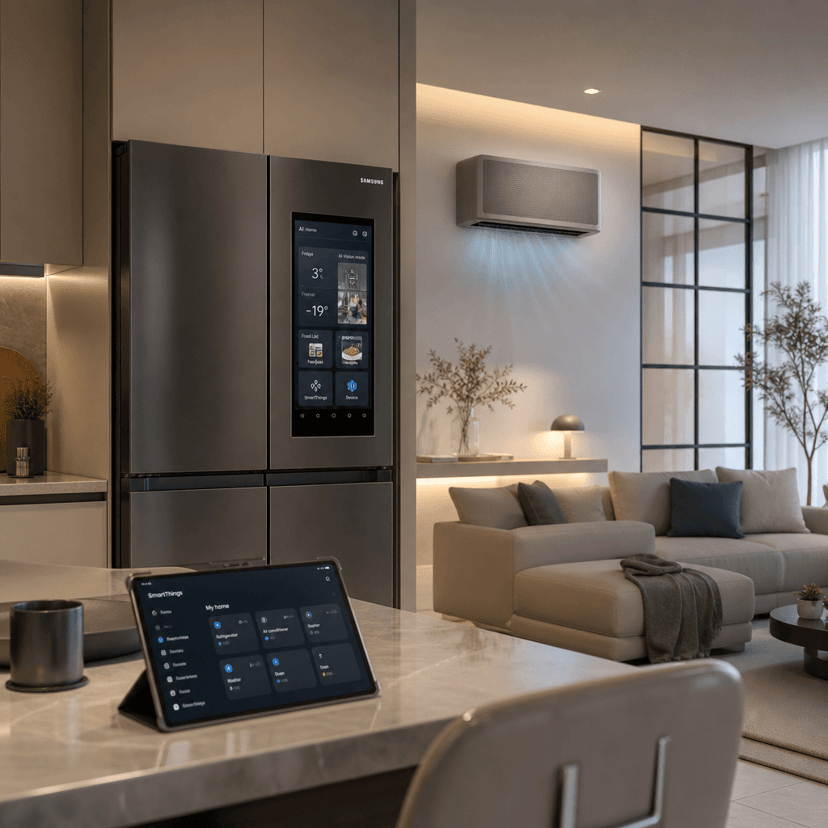
The star of the show is the Bespoke AI Single 1Door Fridge & Freezer, which tackles one of refrigeration's persistent challenges: temperature fluctuations during defrost cycles. AI Precise Cooling, accessible through the SmartThings App, uses machine learning to analyze when you actually open the fridge. It then schedules defrosting for those rare moments when the door stays closed, minimizing temperature swings that degrade food quality. According to Samsung's technical documentation, the system analyzes usage patterns to preserve "taste, texture and freshness of food over time."
But the AI angle is just part of Samsung's strategy. The company's betting hard on seamless design with Auto Open Door—a touch-sensitive system that pops the door open with a light tap. It's a handleless design that sits flush with cabinetry, targeting the minimalist aesthetic driving high-end kitchen renovations. The cooling performance gets a boost from full Metal Cooling, which extends metal ducts across both the rear wall and door surface. This expands on conventional half-sized ducts to speed up temperature recovery after door openings.
On the dishwasher front, Samsung's rolling out an entire lineup calibrated to European energy regulations. The Bespoke AI Dishwasher range spans A-20%, A-10%, A, and B-Grade models, with the most efficient variants hitting 20% better performance than EU Regulation 2019/2014 requires for Grade A classification. That efficiency comes from Active Fan Dry, which cuts heating demand by lowering rinse water temperature and enhancing air circulation. The trade-off? Longer drying times, though Samsung's betting consumers will accept that for lower energy bills.
The cleaning tech is where things get interesting. AI Wash deploys a high-resolution turbidity sensor that measures food particles at every cycle stage. The machine learning algorithm then adjusts wash and rinse duration dynamically—no pre-rinsing needed. "The system automatically adjusts washing and rinsing times to effectively remove stubborn residue," according to Samsung's announcement. The upgraded 3rd Rack Washing System adds dedicated zones for cutlery and drinkware, with six spinning nozzles targeting cups specifically. Samsung claims this frees up space in lower racks by up to a third compared to conventional two-rack models.
Then there's the Extractor Induction Hob, Samsung's answer to open-plan kitchens where traditional range hoods don't fit the aesthetic. It combines induction cooking with integrated ventilation, pulling steam and odors down at the source instead of relying on overhead extraction. In Boost mode, suction hits 720 m³/h—impressive for a downdraft system. Despite that power, it maintains A+ energy efficiency under EU Regulation 65/1024.
The cooking surface uses Anti-Scratch Glass with a Mohs hardness rating of 8. For context, that's the same hardness as a masonry drill bit, versus a rating of 5 for standard ceramic glass, based on Intertek testing per ASTM C1895 standards. A superhydrophobic coating repels residue to simplify cleanup. Flex Zone Plus provides adaptive heating across a 36.5×21 cm area with automatic cookware detection, adjusting heat distribution based on pan size and position.
Maintenance simplification extends to a dishwasher-safe stainless steel grease filter delivering 95% filtration efficiency. An integrated charcoal filter handles odor reduction, though it needs replacement roughly every six months. Samsung's aiming to reduce the friction of owning integrated ventilation systems, where filter maintenance often becomes a pain point.
What Samsung's really doing here is positioning itself against premium European brands like Miele and Bosch while undercutting on price. The AI branding gives it a tech-forward narrative that traditional appliance makers struggle to match. But the real test will be whether consumers see enough value in AI-optimized defrost cycles and turbidity sensing to justify the premium over conventional models. The Bespoke lineup targets buyers renovating high-end kitchens where seamless integration and energy efficiency carry weight. Samsung's betting that AI features—however incremental—become table stakes in that market segment.
The company hasn't disclosed pricing or exact availability dates, but the European focus suggests a regional rollout before potential expansion to North America and Asia. With energy costs climbing and smart home adoption accelerating, Samsung's timing could work. The question is whether "AI" becomes a meaningful differentiator or just another marketing checkbox in an already crowded appliance market.
Samsung's latest Bespoke AI lineup represents a calculated push into premium smart kitchens where design integration matters as much as performance specs. The AI branding—whether it's defrost optimization or adaptive dishwashing—gives Samsung a tech-forward narrative against traditional European appliance giants. But the real battleground isn't AI features; it's whether consumers renovating high-end kitchens see enough value in seamless design and energy efficiency to choose Samsung over established luxury brands. With European energy regulations tightening and smart home adoption climbing, Samsung's timing looks solid. The bigger question is whether AI becomes a genuine differentiator or just another marketing layer in an already saturated premium appliance market. Watch how pricing shakes out when these units hit showrooms.